Peak Uncertainty Sets the Tone for 2025
March 2025
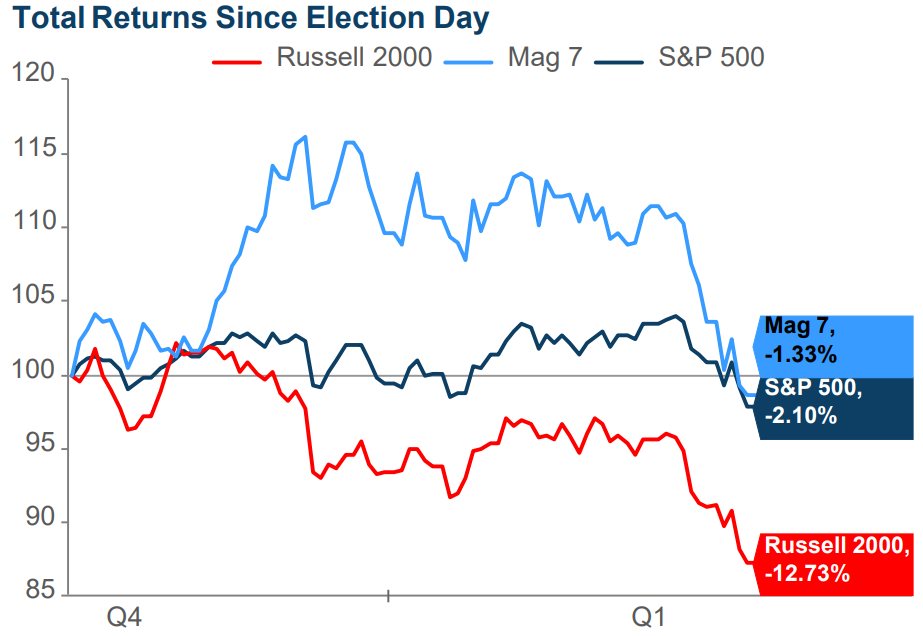
The first months of 2025 have delivered a sharp reminder that markets rarely move in straight lines. Post-election optimism has faded quickly, market leadership has narrowed, and policy uncertainty has surged. With the S&P 500 erasing all post-election gains and investor sentiment deteriorating, we believe capital preservation and selectivity are paramount as uncertainty remains elevated.
Key Takeaways
- Post-Election Gains Have Been Erased: Major equity benchmarks have retraced sharply, with the S&P 500 hovering near its 200-day moving average—a critical technical level.
- Market Breadth Is Weak: Leadership has narrowed considerably, historically a cautionary signal when valuations are elevated.
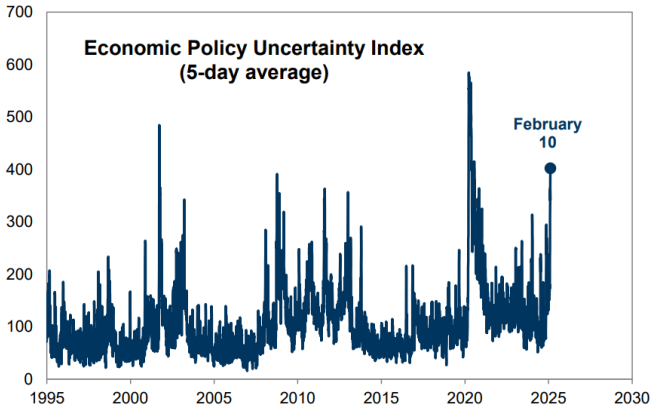
- Policy Uncertainty Is Near Record Levels: Shifting trade, tariff, and regulatory dynamics continue to cloud the outlook.
- Sentiment Is Extremely Negative—but Not Capitulative: While fear has risen, conditions typically associated with durable market bottoms have yet to fully materialize.
A Tumultuous Start to the Year
The opening months of 2025 have been anything but smooth. Markets have reversed many of the trends that emerged immediately following Election Day, erasing approximately $3.4 trillion in equity market value. Risk appetite has faded, market participation has weakened, and tail risks—ranging from geopolitics to inflation—have become more pronounced.
This is no longer an “everything rallies” environment. Instead, investors face a more fragmented market where defensive positioning and discipline matter more than momentum chasing.
Narrow Leadership Raises a Red Flag
One of the most concerning developments beneath the surface is the continued deterioration in market breadth. A shrinking number of stocks are driving overall index performance, while the majority lag behind. Historically, such conditions have often preceded periods of increased volatility and lower forward returns.
Source: FactSet as of 3/5/2025
Concentration, Valuations, and Policy Risk
Equity markets remain highly concentrated, with a handful of mega-cap stocks accounting for a historically large share of index value. At the same time, valuations sit near long-term highs even as earnings expectations face mounting pressure from tariffs, rising input costs, and geopolitical uncertainty.
Policy uncertainty has also surged to levels rarely seen outside periods of significant economic stress. For businesses and investors alike, a lack of clarity around trade, regulation, and fiscal priorities continues to weigh on confidence.
Source: Goldman Sachs Global Investment Research, as of 2/17/20215
Sentiment, Volatility, and the Search for a Bottom
Investor sentiment has turned sharply negative, with several indicators flashing extreme pessimism. Volatility has picked up meaningfully, yet key hallmarks of a durable market bottom—such as broad capitulation and reduced retail participation—have not fully emerged. Retail investors continue to buy dips aggressively, behavior more typical of corrective phases than true troughs.
Navigating Peak Uncertainty
Looking ahead, we believe the market may be poised for short-term relief rallies as oversold conditions develop. However, these tactical moves do little to change the broader backdrop. Stagflation risks, geopolitical tensions, and shifting policy dynamics argue for a more defensive and selective investment approach than investors have needed in recent years.
In this environment, we are emphasizing:
- Margin of Safety: Companies with strong free cash flow, pricing power, and durable competitive advantages.
- Selectivity Within Technology: Elevated valuations and narrowing leadership warrant caution, even as opportunities for active management emerge.
- Patience Amid Volatility: Uncertainty often creates opportunity—but only for those willing to remain disciplined.
While uncertainty can be uncomfortable, it is also an inevitable feature of long-term investing. Navigating periods like this requires focus, patience, and a commitment to quality—principles that remain central to our investment approach.